Protecting Critical Information Resources: Cloud, Remote Computing, Quantum Computing, GDPR and PCI DSS Compliance Cost Proposal
Need help with this assignment?Get an original answer from a qualified tutor — from $10/page.
Get it written →Assignment: Strategic leadership proposal for protecting critical information resources
For this lesson’s assignment, your task will be to compose a proposal that accounts for the strategic leadership challenges to protecting critical information resources from current and future losses. Your report will need to include a discussion on the cost to implement protection for these critical information resources, including quantum computing and compliance requirements such as GDPR and PCI-DSS. The following items must be included in your submission:
- Discussion on new uses for cloud and remote computing vulnerabilities, threats, and compliance
- Discussion on future compliance challenges
- Discussion on what perspective changes there may be for cloud and remote computing vulnerabilities, threats, and compliance with quantum computing
- A quantitative assessment of meeting compliance requirements (provide an estimated cost in tools, services, and employee hours)
Data and users everywhere; identity is the new perimeter
Credential theft, ransomware, third-party and AI risks
GDPR, PCI DSS v4.0.1 and new laws
RSA and ECC must be replaced by 2030–2035
Model proposal
Original example for study purposes (about 1,800 words plus tables). Meridian Retail Group is a fictional company, and all costs are illustrative estimates; replace them with quotes from vendors and your organization’s labor rates.
Proposal: Protecting Meridian Retail Group’s Critical Information Resources From Current and Future Losses
Executive Summary
Meridian Retail Group is an omnichannel retailer with 1,200 employees, 400 of whom work remotely, stores in the United States and an online store that serves customers in the European Union. Our critical information resources are cardholder data, customer personal data, our e-commerce platform and our supply chain systems, most of which now run in public cloud and software-as-a-service (SaaS) environments. These resources face three strategic challenges: cloud and remote work have expanded our attack surface; compliance obligations under the General Data Protection Regulation (GDPR), the Payment Card Industry Data Security Standard (PCI DSS) and new laws are growing; and quantum computing will eventually break the public-key encryption that protects our data today. This proposal recommends a three-year program, with an estimated year 1 cost of $1.43 million in tools, services and employee time, to reduce these risks and maintain compliance.
Strategic Leadership Challenges
Protecting information is a leadership challenge, not only a technical one. Leaders must balance security spending against other priorities, prove the value of preventing events that do not happen, coordinate IT, legal, finance and business units, manage dependence on cloud providers and other vendors and keep pace with a shortage of skilled security staff. The stakes are high: IBM’s 2025 Cost of a Data Breach report found that the average breach cost $4.44 million globally and an all-time high of $10.22 million in the United States (Kapko, 2025). Under GDPR, serious violations can lead to fines of up to €20 million or 4% of worldwide annual turnover, whichever is higher (Regulation (EU) 2016/679, 2016, Art. 83). Card brands can also impose penalties or raise fees for PCI noncompliance.
New Uses of Cloud and Remote Computing: Vulnerabilities, Threats and Compliance
Our use of cloud and remote computing is changing in several ways, and each brings new risks.
- Remote and hybrid work means employees access cloud applications from home networks and personal devices. The main threat is identity compromise through phishing, password reuse, MFA fatigue attacks and stolen session tokens.
- SaaS and multicloud growth means data are spread across dozens of providers. The most common vulnerability is misconfiguration, such as publicly exposed storage, overly broad permissions and unused accounts. Under the shared responsibility model, the provider secures the infrastructure, but we remain responsible for configuration, identities and data.
- Third-party and supply chain risk is increasing. In 2024, attackers used credentials stolen by infostealer malware to access the Snowflake cloud data environments of many customer organizations that had not enforced MFA, leading to data theft and extortion (Mandiant, 2024). The cloud platform itself was not breached; customers’ weak identity controls were.
- Generative AI and analytics in the cloud create new data flows. Employees may paste customer data into unapproved AI tools (“shadow AI”), and AI applications themselves can be attacked. IBM found that 13% of organizations reported breaches involving AI models or applications (Kapko, 2025).
- Ransomware increasingly targets cloud backups and identity systems, so recovery plans must assume that attackers may reach the cloud.
Compliance implications. For GDPR, we must apply “appropriate technical and organisational measures,” including encryption and the ability to restore data, considering “the state of the art” (Art. 32); conduct data protection impact assessments for high-risk processing (Art. 35); report qualifying breaches to the supervisory authority within 72 hours (Art. 33); and use lawful mechanisms, such as the EU–U.S. Data Privacy Framework or standard contractual clauses, for transfers to U.S. cloud services. For PCI DSS v4.0.1, the future-dated requirements that became mandatory on March 31, 2025, now apply in full. They include MFA for all access into the cardholder data environment (8.4.2), management and integrity monitoring of scripts on payment pages to defend against e-skimming (6.4.3 and 11.6.1) and an annual review of the cryptographic cipher suites and protocols in use (12.3.3) (PCI Security Standards Council, 2024). Remote access and cloud segmentation must be documented and tested.
Recommended Controls
- Zero trust identity: phishing-resistant MFA (FIDO2 security keys or passkeys) for all staff, privileged access management, conditional access based on device health and quarterly access reviews.
- Cloud security posture management: continuous scanning of all cloud accounts for misconfigurations against CIS benchmarks and PCI requirements, with automated alerts.
- Zero trust network access to replace the legacy VPN for remote workers.
- Data protection: data discovery and classification, tokenization of card data, encryption with customer-managed keys and immutable backups.
- Detection and response: endpoint detection and response, centralized logging and a 24/7 managed detection service.
- Third-party risk management: security requirements in contracts, MFA enforcement for all SaaS tenants and annual vendor reviews.
- AI governance: an approved AI tools list, data loss prevention rules and training on acceptable use.
- Cryptographic agility and post-quantum readiness (discussed below).
Future Compliance Challenges
Compliance will become more complex in the next five years:
- A growing patchwork of laws. In addition to GDPR, roughly 20 U.S. states have comprehensive privacy laws with different definitions and rights, and new EU laws such as the NIS2 Directive, the Digital Operational Resilience Act for financial services, the Data Act (applicable since September 2025) and the AI Act add security, resilience and transparency obligations. Overlapping requirements raise costs and increase the chance of gaps.
- AI regulation and accountability. Using AI on customer data will require risk assessments, documentation and transparency, and regulators are still developing guidance.
- Data sovereignty. Rules on where data may be stored and processed, and uncertainty about the long-term stability of EU–U.S. data transfer frameworks, may force changes to our cloud architecture.
- Faster incident disclosure. GDPR’s 72-hour rule, the U.S. Securities and Exchange Commission’s cyber incident disclosure rules for public companies and state breach laws require mature detection and response.
- Continuous compliance. PCI DSS v4.0.1 emphasizes security as a continuous process, with targeted risk analyses and ongoing monitoring rather than an annual check.
- Cryptographic mandates. Standards bodies are now setting deadlines to replace quantum-vulnerable cryptography, which will flow into PCI, GDPR “state of the art” expectations and customer contracts.
How Quantum Computing Changes the Perspective
A cryptographically relevant quantum computer running Shor’s algorithm could break the public-key algorithms that secure nearly all cloud and remote connections today, including RSA and elliptic curve cryptography (ECC), which protect TLS sessions, VPNs, digital signatures and software updates. Grover’s algorithm weakens symmetric encryption less severely, so AES-256 remains appropriate. Although no such computer exists yet, quantum computing changes our risk perspective in four ways.
- Harvest now, decrypt later. Attackers can steal encrypted data today and decrypt it once quantum computers are available. Data that must remain confidential for many years, such as customer identities and long-term contracts, are already at risk.
- Firm deadlines. NIST published its first post-quantum standards in August 2024, FIPS 203 (ML-KEM), FIPS 204 (ML-DSA) and FIPS 205 (SLH-DSA), and selected HQC as a backup algorithm in March 2025. In October 2026, NIST finalized IR 8547, which deprecates quantum-vulnerable public-key algorithms such as RSA and ECC after 2030 and disallows them after 2035 (Cloud Security Alliance, 2026; National Institute of Standards and Technology [NIST], 2024). The European Commission’s coordinated roadmap calls for organizations to begin transitioning by the end of 2026 and to protect high-risk use cases by the end of 2030 (European Commission, 2025).
- Compliance meaning shifts. GDPR requires security measures that reflect “the state of the art,” and PCI DSS 12.3.3 already requires us to monitor cryptographic viability and plan for changes. As post-quantum standards mature, continued reliance on RSA alone for long-lived sensitive data may be viewed as falling short of these expectations.
- Cloud dependency. Much of the migration will happen through our cloud, CDN and SaaS providers, many of which already support hybrid post-quantum key exchange (classical ECDH combined with ML-KEM) in TLS. Our role is to inventory where cryptography is used, prioritize systems by data lifetime, require PQC roadmaps from vendors and build crypto-agility so algorithms can be swapped without redesigning systems.
Post-quantum roadmap for Meridian: Year 1: cryptographic inventory and risk ranking; vendor PQC requirements in contracts; pilot hybrid TLS for the e-commerce site. Year 2: migrate VPN/ZTNA, internal PKI and code signing to hybrid or PQC algorithms as products support them. Year 3: complete migration of high-risk systems and retire RSA/ECC where possible ahead of the 2030 deprecation date.
Quantitative Assessment of Meeting Compliance Requirements
The tables below estimate year 1 costs to meet GDPR and PCI DSS requirements and prepare for post-quantum cryptography. Tool and service prices are based on typical market ranges for a mid-size organization, and employee hours use fully loaded hourly rates.
| Item | Requirement addressed | Estimated annual cost |
|---|---|---|
| Tools | ||
| Cloud security posture and workload protection (CNAPP) | Cloud misconfiguration, PCI 1–2, GDPR Art. 32 | $120,000 |
| Zero trust network access/SASE for 400 remote workers | Remote access, PCI 1, 8 | $48,000 |
| Endpoint detection and response (1,500 devices) | PCI 5, GDPR Art. 32 | $90,000 |
| SIEM and log management (12-month retention) | PCI 10, GDPR Art. 33 breach detection | $110,000 |
| Phishing-resistant MFA keys and privileged access management | PCI 8.4.2, 8.3.10.1 | $130,000 |
| Payment page script monitoring | PCI 6.4.3, 11.6.1 | $25,000 |
| Cryptographic discovery and inventory tool | PCI 12.3.3, PQC readiness | $60,000 |
| Privacy management platform (records, DSARs, consent) | GDPR Arts. 15–22, 30 | $40,000 |
| Tools subtotal | $623,000 | |
| Services | ||
| Qualified Security Assessor (QSA) audit and Report on Compliance | PCI DSS validation | $75,000 |
| Quarterly approved scanning vendor (ASV) scans | PCI 11.3.2 | $8,000 |
| Annual penetration and segmentation testing | PCI 11.4 | $45,000 |
| External data protection officer and privacy counsel, including DPIAs | GDPR Arts. 35, 37–39 | $60,000 |
| Post-quantum migration roadmap and vendor assessment | NIST IR 8547, EU PQC roadmap | $80,000 |
| Services subtotal | $268,000 | |
| Employee activity | Hours per year | Loaded hourly rate | Cost |
|---|---|---|---|
| Compliance program management | 1,040 | $85 | $88,400 |
| Cloud security and PQC engineering | 2,080 | $95 | $197,600 |
| IT operations: patching, configuration, logging | 1,200 | $75 | $90,000 |
| Privacy operations: DSARs and vendor reviews | 600 | $80 | $48,000 |
| Security awareness training (1,200 staff × 2 hours) | 2,400 | $40 | $96,000 |
| Incident response tabletop exercises | 160 | $95 | $15,200 |
| Employee hours subtotal | 7,480 | $535,200 |
| Summary | Year 1 estimate |
|---|---|
| Tools | $623,000 |
| Services | $268,000 |
| Employee hours (7,480 hours) | $535,200 |
| Total | $1,426,200 |
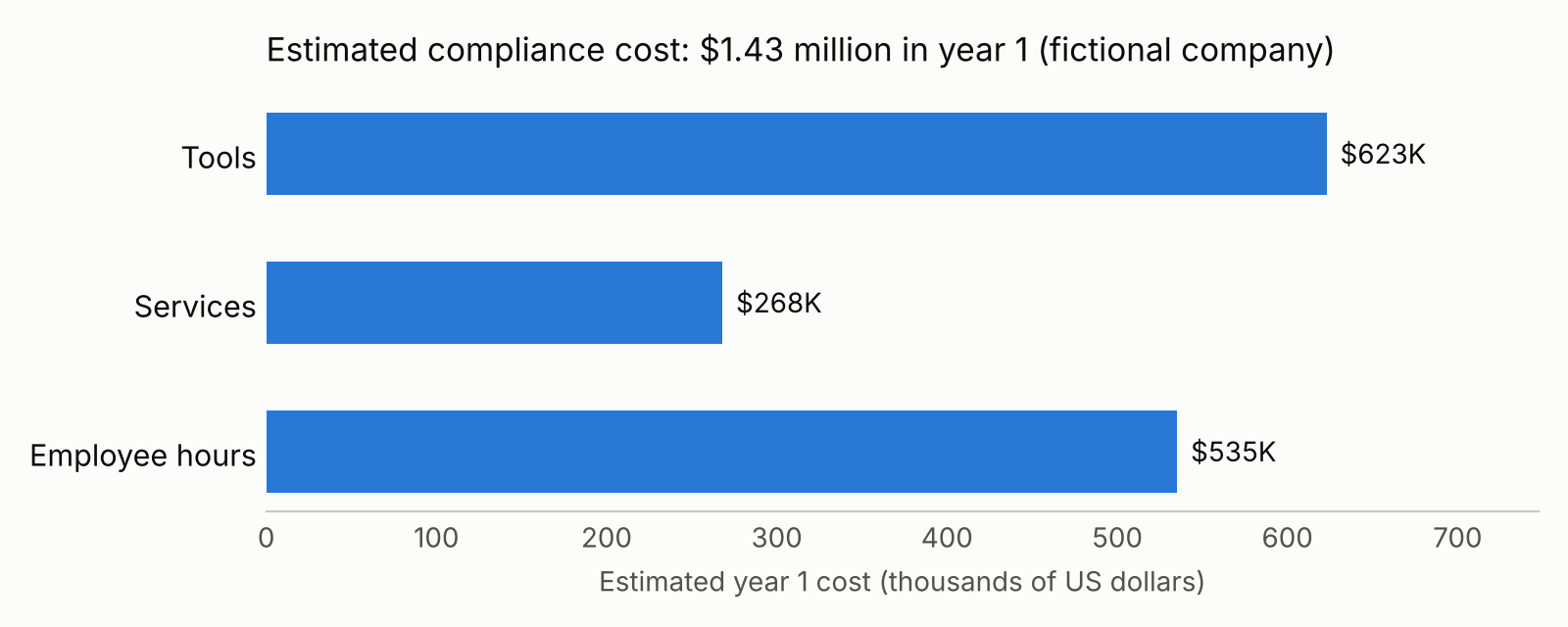
Interpreting the estimate. The total year 1 investment of about $1.43 million includes roughly 7,480 employee hours, the equivalent of about 3.6 full-time staff. Years 2 and 3 would likely cost less (about $1.1–1.2 million per year), because one-time consulting and setup work decreases, although PQC migration work will continue. Compared with an average U.S. breach cost of $10.22 million (Kapko, 2025) and potential GDPR fines of up to 4% of global turnover, the program is justified if it reduces the annual probability of a major breach by even 15%: 0.15 × $10.22 million ≈ $1.53 million in avoided expected loss, which exceeds the annual cost. Additional benefits include lower cyber insurance premiums, faster audits and customer trust. Leadership should treat these figures as a planning baseline and refine them with vendor quotes.
Implementation and Governance
The chief information security officer would sponsor the program and report quarterly to the executive team and board, using metrics such as the percentage of users on phishing-resistant MFA, critical cloud misconfigurations open longer than 14 days, time to detect and contain incidents, PCI and GDPR audit findings and the percentage of systems inventoried for cryptography. A cross-functional governance committee with IT, legal, privacy, finance and business leaders would approve risk decisions and budget changes.
Conclusion
Cloud and remote computing have made our critical information resources more accessible and more exposed, compliance obligations are expanding and quantum computing sets a clear deadline for replacing today’s encryption. By investing in zero trust identity, cloud security, continuous compliance and crypto-agility now, Meridian can reduce the likelihood and impact of losses, meet GDPR and PCI DSS requirements and prepare for the post-quantum era at a manageable, predictable cost.
References
Cloud Security Alliance. (2026, October 30). NIST IR 8547 final: Post-quantum deadlines become vendor requirements [Research note]. https://labs.cloudsecurityalliance.org/research/csa-research-note-nist-ir8547-pqc-transition-20261030-csa-st/
European Commission. (2025). A coordinated implementation roadmap for the transition to post-quantum cryptography. https://digital-strategy.ec.europa.eu/en/library/coordinated-implementation-roadmap-transition-post-quantum-cryptography
Kapko, M. (2025, July 30). Research shows data breach costs have reached an all-time high. CyberScoop. https://cyberscoop.com/ibm-cost-data-breach-2025/
Mandiant. (2024, June 10). UNC5537 targets Snowflake customer instances for data theft and extortion. Google Cloud Blog. https://cloud.google.com/blog/topics/threat-intelligence/unc5537-snowflake-data-theft-extortion
National Institute of Standards and Technology. (2024, August 13). NIST releases first 3 finalized post-quantum encryption standards. https://www.nist.gov/news-events/news/2024/08/nist-releases-first-3-finalized-post-quantum-encryption-standards
PCI Security Standards Council. (2024). Payment Card Industry Data Security Standard: Requirements and testing procedures (Version 4.0.1). https://www.pcisecuritystandards.org/
Regulation (EU) 2016/679 of the European Parliament and of the Council of 27 April 2016 (General Data Protection Regulation). (2016). Official Journal of the European Union, L 119, 1–88. https://eur-lex.europa.eu/eli/reg/2016/679/oj
Before you submit: replace the fictional company with your own organization or case, adjust the costs to your size and region and explain your assumptions. If your instructor wants scholarly sources, add peer-reviewed articles on post-quantum migration and cloud security from your library database.
Frequently asked questions
When must organizations stop using RSA and ECC?
Under NIST IR 8547, finalized in October 2026, quantum-vulnerable public-key algorithms are deprecated after 2030 and disallowed after 2035 for systems that follow NIST standards. Many organizations are starting with hybrid approaches now because of the harvest-now, decrypt-later threat.
Which PCI DSS version applies in 2026?
PCI DSS v4.0.1 is the active version, and its future-dated requirements became mandatory on March 31, 2025.
Related reading: identity and remote access defense design, cloud contracts, laws and networking and cloud security vulnerability assessment.
More model assignments posted today
- SCS 224 journal: Haiti clean water study
- SCS 224 journal: gang violence research
- SCS 224 journal: uncontacted tribes of Brazil
- Accreditation and curriculum development
- Supply chain risk PowerPoint
- Neurocognitive psychiatric evaluation
- Concurrent access and data integrity
- Philosophical assumptions of science discussion
Get a plagiarism-free answer to this question
Send us your instructions and we’ll match you with the best writer in your subject.
- 100% human-written, zero AI
- Turnitin report included
- Confidential — we never share your data
- Free revisions & refunds